Why 4-Letter Domains Are Valuable: Scarcity, Branding, and Resale
Why are 4-letter domains valuable enough that investors hold them in bulk portfolios and startups pay four or five figures for the right one? The answer is not fashion. LLLL.com prices rest on four structural drivers — fixed supply, branding utility, global demand, and resale liquidity — and none of them depend on trends.
Fixed supply: 456,976 and no more
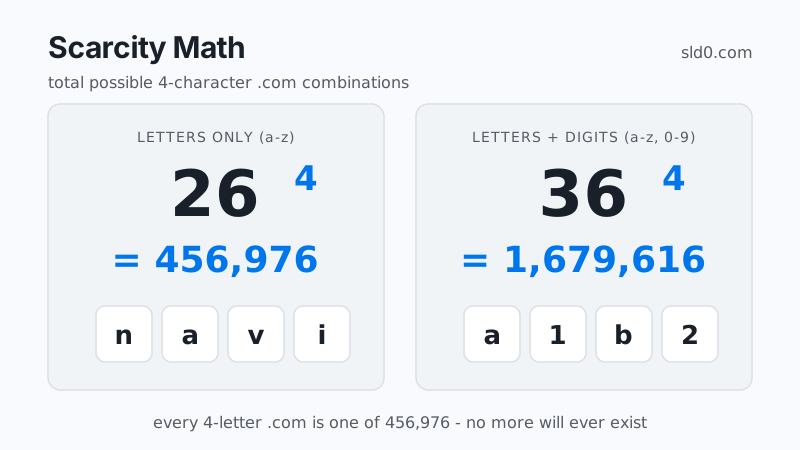
Every store of value starts with scarcity, and LLLL.com has the cleanest scarcity in the domain world. There are 26^4 = 456,976 four-letter .com combinations. That number cannot grow. It is set by the alphabet and the rules of the DNS, not by any registry policy.
Every one of those combinations has been registered since 2013. New supply enters the market only when an existing holder sells on the secondary market or lets a name lapse into the expiry pipeline. Compare that with almost any other domain category — long keywords, new TLDs, invented strings — where supply is effectively unlimited. When someone registers a fresh alternative for $10, the ceiling on your name's value disappears. With LLLL.com, there is no alternative faucet.
Branding utility: four letters work everywhere
Scarcity alone does not create value — plenty of scarce strings are worthless. Four-letter names have a second leg: they are genuinely useful to end users.
- Memorability. Four characters fit in a glance. They survive the "radio test" — say the name aloud and a listener can spell it or at least find it.
- Versatility. A four-letter string works as a company name, a product name, an acronym, or a ticker-style token. It is short enough to sit on an app icon, a jersey, or a slide header.
- Neutrality. Pronounceable four-letter names like
vano.comormepo.comare blank canvases. They carry no legacy meaning, so a brand can pour its own meaning into them — the same dynamic that made names like Hulu or Zynga workable.
This is why buyers are not just investors. The end-user pool includes startups rebranding, crypto and fintech projects wanting ticker-style identities, and companies shortening a long corporate name to initials.
Global demand, especially across language barriers
Short letter strings travel across languages better than words. A four-letter .com with no dictionary meaning in English can still be pronounceable in Mandarin, Spanish, or German. Demand from Chinese investors has historically been a major force in the LLLL.com market — at one point buying pressure from China repriced the entire category and established the concept of a "floor price" for even the ugliest four-letter combinations.
Global demand matters because it broadens the eventual buyer base. A name that means nothing in one market may match an acronym, a pinyin initialism, or a brand concept in another. You are not betting on a single language's fashion.
Resale liquidity: the LLLL.com floor price
The fourth driver is the one investors care about most: you can actually sell these names. LLLL.com is one of the few domain categories with something like a commodity market. Because the set is small and well-defined, there is enough transaction history for the market to price even the least attractive combinations — random strings heavy in q, x, z, and j — at a recognizable "floor."
Above the floor, prices tier by quality:
- Random strings like zqvx.com trade at or near the floor.
- Semi-pronounceable patterns command a multiple of the floor.
- CVCV and dictionary-adjacent names like quva.com sit at the top of the retail range, sold to end users rather than investors.
Liquidity changes the risk profile. Buying an obscure long domain is a lottery ticket; buying a 4-letter .com near the floor is closer to holding a thin but real asset with a quoted bid. Portfolio holders know roughly what they can liquidate and at what discount.
What this means if you are buying
The value drivers suggest a practical hierarchy. If budget allows, letters-only names from the premium LLLL.com list hold value best. If you are price-sensitive, mixed 4-character names from the main index give you the brevity without the scarcity premium — useful for a project that just needs a short handle. And if you are patient, the drop pipeline occasionally releases letters-only names at registration fee, which is the closest thing to a free lunch this category offers.
Four-letter domains are not valuable because of hype cycles. They are valuable because the supply is capped at 456,976, the names are useful to real businesses, demand spans languages, and a functioning resale market prices even the bottom of the barrel. That combination is rare in any asset class.