4-Letter vs 4-Character Domains: Letters, Digits, and Hyphens
"4-letter domain" and "4-character domain" sound interchangeable, but in the market they are different categories with very different values. Letters, digits, and hyphens each follow their own rules, and knowing where a string falls in the 4-letter vs 4-character comparison tells you most of what you need to know about its price and liquidity before you look at anything else.
The Pattern Classes
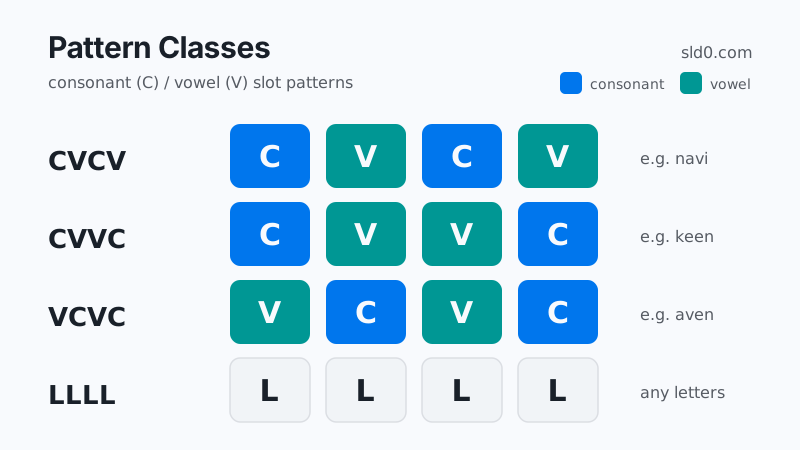
Every 4-character .com belongs to one of a few pattern classes:
- LLLL — four letters (the classic 4-letter domain)
- NNNN — four digits
- Mixed — any combination of letters and digits (LNLL, LLNL, LNLL, and so on)
- Hyphenated — strings containing one or more hyphens
LLLL: The Benchmark
Four-letter .com domains are the benchmark everything else is measured against. There are 456,976 of them, they are all registered, and they trade in a genuine market with a wholesale floor and retail upside. They work as acronyms in any language, they fit Chinese premium letter dynamics, and they pronounce well enough for Western brands. If someone says "4-letter domain" without qualification, this is what they mean.
You will not find LLLL names available at registration fee outside of drops — that is precisely why the premium LLLL.com section and the expiring pipeline exist.
NNNN: The Digit Market
Four-digit .com domains are their own world, driven almost entirely by Chinese demand. Numbers carry strong cultural meanings in Chinese — some auspicious, some avoided — and numeric domains need no translation, which makes them attractive across language barriers. The NNNN space has its own premium logic (certain digits and combinations are favored) that shares almost nothing with letter-based valuation.
If your interest is the letter market, treat NNNN as an adjacent category rather than a substitute.
Mixed Patterns: LNLL and Friends
Mixed letter-digit strings are where the 4-character space opens up for ordinary buyers. There is no investor floor under these names, but there are far more combinations, and they turn over — meaning you can actually find them on the available list or catch them as they drop, often at registration fee.
When do mixed patterns make sense?
- Web3 and tech naming. Project and token culture normalizes letter-digit brands, so a pattern that would look odd for a law firm reads naturally for a protocol or developer tool.
- Gaming tags and handles. Gamers have used leetspeak and digit-mixed handles for decades; a name like x7rk.com fits that world fine.
- Semantic digits. When the digit means something — "4" for "for", "2" for "to", a meaningful number in the brand — a mixed name can outperform a random LLLL string for that specific buyer.
The trap is assuming a mixed name has resale value by default. It does not. Register them for a use, not for speculation.
Hyphenated 4-Character Domains
Hyphens are legal in domain labels with one hard rule: a label cannot start or end with a hyphen. So -abc.com and abc-.com are not registrable at all, while a-bc.com is technically valid.
Technically valid, but rarely desirable. Hyphenated names are harder to say aloud ("a dash b c"), easy for visitors to mistype, and long associated with low-quality sites. In the 4-character space specifically, adding a hyphen removes you from every established market — no LLLL floor, no NNNN demand — while making the name harder to use. There are edge cases, but as a rule a hyphenated 4-char name is worth less than the same string without the hyphen, which is itself usually a mixed name with no floor.
Which Should You Choose?
The comparison resolves to intent:
- Investment or resale: LLLL only. It is the class with liquidity, comparables, and a floor.
- A brand on a budget: consider mixed patterns, but only when the digit earns its place semantically or culturally for your audience.
- Numeric demand: NNNN, understanding you are playing the Chinese number market.
- Hyphens: almost never.
Browse the available 4-character list with these classes in mind and the difference becomes obvious fast — check a detail page like bq4t.com against a letters-only name and you will see the pattern distinction is the valuation.