Chinese Premium Letters: How the Chinese Market Values LLLL.com
If you spend any time around LLLL.com markets, you will hear the term Chinese premium letters within the first five minutes. It is the single most important pricing distinction in the four-letter space, and it explains why one random-looking string can be worth multiples of another that seems identical. Understanding it is essential before you register, bid, or price anything.
What Are Chinese Premium Letters?
The Chinese premium letters are the 20 consonants of the English alphabet excluding v, plus the remaining letters once you remove the vowels. In practical terms, the letters a, e, i, o, u, and v are considered non-premium, and the other twenty letters are considered premium.
The reasoning comes from pinyin, the romanization system for Mandarin Chinese. Pinyin syllables begin with consonant initials, and Chinese brand names, company names, and acronyms built from pinyin initials therefore lean heavily on consonants. Vowels rarely stand alone as initials, and v does not appear in pinyin at all. A four-letter string made only of the twenty premium letters can plausibly read as the initials of a Chinese company name. A string full of vowels generally cannot.
So a name like bqtd.com fits the acronym pattern a Chinese buyer might want, while aeou.com reads as vowels to almost everyone. Both are four letters. Both are .com. The market treats them very differently.
Scarcity Does the Rest
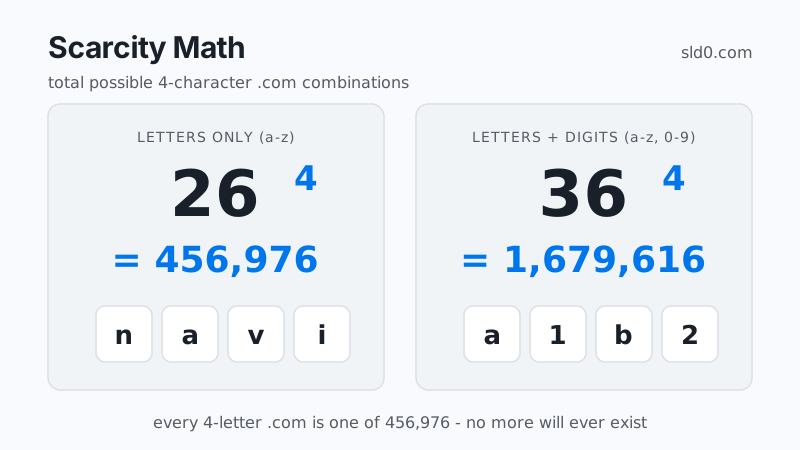
The math is worth stating plainly. There are 456,976 possible LLLL.com combinations in total, and every single one was registered years ago. Restrict yourself to the twenty Chinese premium letters and you get 20^4, or 160,000 combinations — roughly a third of the full set. These are also all registered.
That fixed supply is the foundation of the whole market. Nobody can mint a new premium-letter LLLL.com. When demand rises, prices move because supply cannot.
The 2015 Chinese Demand Wave
Before 2015, four-letter .com names traded mostly among Western domain investors at modest levels. Then, during 2015, Chinese buyers entered the short-domain market in large numbers. Demand concentrated on exactly the categories that fit Chinese naming habits: all-consonant letter strings, number domains, and short combinations generally.
The result was a rapid, broad repricing. Chinese premium LLLL.com names went from low-value inventory to a recognized asset class with an established wholesale floor, and the wave pulled up adjacent categories — including many non-premium letter names — along with it. The market has cooled and reheated since then, but the premium/non-premium distinction the 2015 wave cemented never went away. It is still the first thing a dealer checks.
What This Means for Western Buyers
A few practical takeaways:
- Letter quality is the floor. A premium-letter LLLL.com tends to hold a wholesale value regardless of whether it spells anything in English. Non-premium names depend much more on end-user appeal — pronounceability, acronym fit, brand potential.
- Non-premium is not worthless. Vowel-heavy names are often the most pronounceable for Western brands. A name like
ezlo.comis non-premium by the Chinese definition but attractive to an English-language startup. You just cannot rely on the Chinese-investor floor under it. - Acronyms cut both ways. Western companies also buy acronym domains. A string of consonants can just as easily be the initials of an American or European firm.
Checking Letter Quality Before You Buy
The fastest filter is simply to look at the letters. Vowels and v drag a name out of the premium tier; all-consonant strings sit inside it. From there, browse the letters-only LLLL.com section to see what premium inventory actually looks like, and pull up individual names on their detail pages — something like zqvx.com, which is non-premium because of the v, compared with a consonant-only string — to build your intuition.
If you are hunting registrations rather than resales, the available 4-character list shows what can still be hand-registered, and the expiring pipeline shows premium-letter names working their way toward a drop.
Chinese premium letters are not a fad category. They are the market's baseline pricing grammar for LLLL.com, and any valuation you do — buying or selling — starts with those twenty letters.